

Before You Dismiss Pop Music, Give It An "Academic Listen"
On poptimism, anti-pop snobbery, and how to give the likes of Taylor Swift and Charli XCX the kind of close listen usually reserved for “serious” music.


This essay is one of my favorites from the archive, and I’m dusting it off not just because most of you missed it, but because whether you like it or not, (anti)poptimism refuses to die.
Rock revival is back in the cultural ether. After a few heady summers back in the club, mainstream appetites are hungry for rock again. Even pop princess Charli XCX is literally making Rock Music now. It’s a perpetual cycle, and we’re seeing the pendulum swinging back already from when this essay was originally published.
So yes, we’re technically talking about pop music, but this discussion applies to almost anything that might set off your internal “absolutely not” alarm. Be it taste, exhaustion, or hype aversion, there are reasons why we all might turn up our noses at music before giving it a real chance. Here, Rita (aka The Ririverse, musician and author of Fear of Music) shows us a useful little crowbar for prying open a song you thought had nothing for you, especially if you thought it was too facile or otherwise “beneath” you.
Keep your ears open, kids.
xo
Gabbie

What is poptimism?
(And maybe… what is pop?)
A-ah, pop music! Don’t we all have an opinion on it? It’s great, it’s primitive, I’ll sell my kidney to buy a show ticket that costs $1,000, you’re crazy, this is the best poetry since Shakespeare, what a shallow piece of garbage!
You get the point.
I gotta say, I’d never heard the term “poptimism” until Gabbie brought it up in the comment section of my post about The Bee Gees. It was only later that I found out people use “poptimism” in direct opposition to so-called “rockism” — think of it like choosing to shake it off instead of living on a prayer.
Now, is poptimism good or bad? Kind of both - or rather, it depends on whose head you’re in.
Does pop music matter? Yes.
Is pop music the only kind of music that matters? Hell no.
Loving any kind of music is great, but the cultural implications about said music always change dynamically. A couple of years ago, I read Ted Gioia’s “Music: A Subversive History,” in which he promotes an idea of an institutionalization cycle that music experiences – an idea that has stuck with me ever since.
Essentially, it implies that all highbrow music at some point was underground, ostracized, frowned upon by the ruling class, treated as a disruptive element to society. After a new, rebellious type of music inevitably becomes popular (despite all the effort to shut it down), the elite have nothing left to do other than jump on the bandwagon and pretend they’ve approved of it all along.
This is exactly the moment when the music that was once a symbol of rebellion becomes part of the establishment. It is now omnipresent, prescriptivist, rigid and stale.
A new rebellion is brewing somewhere in the gutters. This cycle seems awfully reminiscent of this whole dynamic of rockism and poptimism. Rock is dead, long live pop.1
But is the death of pop actually close? To be quite honest, I don’t think so.
The thing is, pop as such is an insanely broad genre. Taylor Swift is pop. ABBA is pop. Sabrina Carpenter is pop. Fleetwood Mac, for all intents and purposes, is pop. The Bee Gees are pop. A lot of the Beatles’ material, if you ask me, could be classified as pop.2
This, in turn, reminds me of the scene at the end of the “Get Back” documentary where John, Paul, George and Ringo are playing their rooftop show in the center of London.
There’s a split-screen showing the band’s crew as they interview bystanders, and they’re asking questions like: “Do you like what you’re hearing?” “Can you guess who’s playing?” “What do you think of The Beatles?” “What do you think of their new material?”
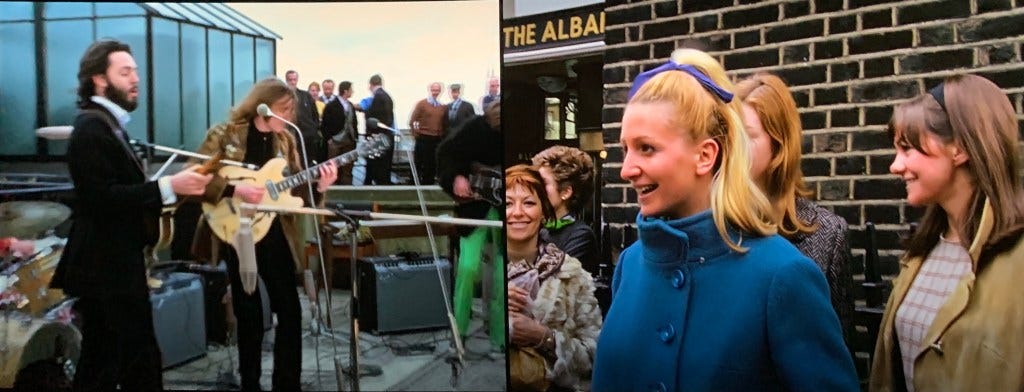
People mostly speak of the band with great affection. But then there’s one young guy, dressed in office attire, hair combed neatly to the back, drenched in hair gel. He takes a lot of pleasure in telling the interviewer how much the Beatles suck and how he’s so special for seeing right through them. Their music is just beneath him.
As time has shown, this guy is in the minority. Ultimately, his “expert” opinion doesn’t matter.
Yet on a certain level we might be able to understand him. And modern day antipoptimists aren’t so different from him.
Know somebody who hates pop? Send this article to them and get paid access for free.
What about fandom?
Back in the day, hordes of young girls were so excited to see The Beatles live that they would leave the seats of the venue drenched in piss after the shows. They would scream so loudly that neither the audience nor the band themselves could hear the actual music, which is ultimately why the Beatles stopped performing live.
At this point, are the fans actually in love with the music, or with the idea of their idols?3
Radical fandom hasn’t disappeared. Today, it’s taken on some new forms — potentially concerning parasocial relationships, perhaps.
For the antipoptimists in the room, ask yourself this:
Do you hate the music that much, or do you actually just hate the fans?
Is it possible that you want to extra-hate the music in order to distance yourself from the kind of fan behavior that doesn’t sit right with you?
I am not much of a modern pop-music fan myself. While there are definitely some gems in the mainstream music landscape that I find awesome, I mostly look at the products of pop-industry dispassionately, with more of an analytical interest. I have never intentionally listened to a Taylor Swift song, or a Sabrina Carpenter song, or a Chappell Roan song.
But when I hear one, I understand - from a pure songwriting perspective - why people would like them so much. I invite you to try the same.
Let’s look at it based on two examples that Gabbie gave me for analysis…
Deconstructing Pop Songs
SONG NO. 1. “SHAKE IT OFF” by Taylor Swift4
I once did a decomposition of this song for a Substack livestream on hyper-popular songs. While I personally don’t connect with it on an emotional level, I think it’s a textbook example of a masterfully written pop song.
I invite you to give it an “academic listen” and pay close attention to how it develops.
The song starts with a groovy beat, then adds minimal ostinato instrumentation complemented by instantly high-energy vocals. The verse vocal figure repeats a few times, and before you can get bored of it, the song goes into the bridge and then the chorus.
Now, the chorus melody is nothing if not infectious. Once you’ve heard it, you’re never gonna forget it. It can be argued whether this is great or horrible but for the purpose of my analysis this is just an empirical fact. I say: “Haters gonna…”, - and your brain goes: “…hate, hate, hate, hate, hate”.
While we’re at it, notice how more instruments are added in the chorus and how once we go into verse two, just for a couple of lines, everything but the brass ostinato cuts out. Dynamics, yay! Now that the beat comes back seconds later, our brains are gonna feel happy.
As we move deeper into the second verse, Taylor adds a counter melody repeating the verse lyrics - more new details, and at the same time more of the familiar stuff - an ingenious move for a pop song to stimulate our brains’ love for both repetition and subversion of expectations (read more on it in Dan Levitin’s “This Is Your Brain on Music”). Then, before you know it, her vocals are harmonized - again, melodies that we’ve already heard but with a new twist.
And then we get to chorus number two - and this time the instrumental is fuller than in the previous one. We have a whole brass section added to the mix. And right after, we’re given this entirely new post-chorus section hammering the “shake it off” of it all into our minds.
Moving on - another new section with a spoken-word delivery. It’s distorted, it’s sassy, it’s groovy - and it’s all unknown. It tickles our brains and it makes us long for the resolution to something we already know - the chorus. And boy does it resolve into that chorus! It does so with a big “Yeeeeaaaaahhooooohhh!” and this last chorus is full of supporting harmonies, countermelodies - every “side-story” the song has been teasing is happening at once. It’s a full explosion of joie de vivre, right there.
And mind you: I don’t like this song. However, it is likeable. In fact, if the research laid out in “This Is Your Brain on Music” is right, our brains are basically wired to like it, the way that it’s built.
If this kind of close listening is useful to you, you’ll get way more of it as a paid subscriber. Hang out with us in the Discord where the music rabbit holes are endless.
SONG NO. 2. “VON DUTCH” by Charli XCX
Alright, this song I find genuinely fantastic - it’s probably my love for Magdalena Bay and experimental pop speaking. While I had inadvertently stumbled upon “Shake It Off” before, I’d never heard “Von Dutch” until Gabbie showed it to me. As I was listening to it for the very first time, I found it hard to believe that this song comes from the most hyped album of 2024. Screw it, I was sincerely overjoyed that songs with such an unhinged devil-may-care production make it into the mainstream.
Curiously, I think the two songs I’m analyzing today are sort of the antipodes of each other. “Shake It Off” is a shiny, perfect, ideally formulaic pop-song with a shiny, perfect, ideally formulaic production. “Von Dutch” is like a deformed alien smuggled straight out of Area 51.
I was sincerely overjoyed that songs with such an unhinged devil-may-care production make it into the mainstream.
Here, we’re also dealing with great songwriting. “Von Dutch” is very easy to sing along to. Its main melody is very repetitive, hitting the same note on every syllable, right until the end of each line where it drops by a tone. This monotony makes it all the more satisfying every time we stumble upon a line where instead of going down, Charli goes up a fifth - a huge leap compared to how the rest of the vocal melody is built.
That being said, it’s really the production that sets this song apart and gives it such a high relisten value. Just like in “Shake It Off”, “Von Dutch” plays with intensity, dynamics and instrument combinations.
In the intro we only hear the drum-machine beat, the string synth and the monotonous vocal melody. The song slowly starts to build up with the repetition of “I’m your number one” (ha, repetition!) and then, suddenly, the beat drops and that’s the moment when IT ALL HAPPENS.5
Why suddenly? Because the way it happens is so trippy it subverts every expectation you might have had. Technically the vocals treat the first beat of the measure as the downbeat, but it seems like the drums and the bass REALLY drop only on the second beat. This creates a weird, jagged feeling; a deformed alien you can’t stop looking at.
Pretty soon another sound comes into the mix - one that should be extremely unpleasant taken out of context - a weird screeching sample that reminds me of a massive train doing an emergency braking maneuver. Here it creates this amazing push and pull sensation, while the beat and especially the bass give the song a crazy groove - akin to a kamikaze motorbike ride - the screeching braking sample acts as sort of a resistor.
Later in the song, the groove drops out for what seems to be a bridge section only to explode again and stay for the rest of the track until it finally dissipates in a high-pass filter.
“Wow” is all I can say here.
“If you have shame, you’re lame.”
What’s the moral of this story? Listen to whatever music you want - there is no shame in liking something or disliking something. Adore Taylor Swift or don’t, lose your shit (piss?) about The Beatles or don’t. It’s all there for you - you only have to press play.
For discussion…
Are we, in fact, seeing the death (or slowing, at least) of pop and an upswing of rock?
What songs did you find a new appreciation for after examining them more carefully?
Is there an artist or genre you’ve written off because of the fans rather than the music itself?
Give an example of “the exciting part” of a particular song that gives you chills - the part WHERE IT ALL HAPPENS, as Rita says.
Remember the cycle I noted in the intro? We’re back on the other side of this now, or at least we’re seeing the beginnings of this. That eternal pendulum swing, and it came around so quickly! -G
This is a fascinating take to me that proves Rita's point even more, because from my perspective, the Beatles are the platonic pop ideal. They are quintessentially pop by all standards. -G
This continues to be a massive foundational argument against poptimism to this day. Now we call it "stan culture," and the rabidity of fans (stans) is often pointed to as a barrier to legitimate criticism of pop stars. That is to say, fans are so obsessive and protective that they treat any criticism, no matter how mild or how legitimate, as grounds for cancelation (and worse — I have a close friend who received death threats for giving a Katy Perry album a low rating once). But does that mean pop music itself isn't any good, just because some fans reach this level of delusion? -G
For the record, my feelings about this song are purely neutral. I recognize that it is very popular but I don't personally love it, nor do I hate it. -G
Many, many years ago, when I was but a dewy youth in college, I had a transformative conversation with a friend of mine about music. We discussed what he called "the exciting part" in songs, way before Skrillex, way before the mainstream was talking about beats dropping. It's something that Rita gets at here from an actual music production perspective, though "the exciting part" doesn't necessarily refer to a literal beat drop; rather, it’s the moment in any song that makes your heart skip a beat or your skin tingle. In Von Dutch, "the moment when IT ALL HAPPENS" after the repetition of "I'm your number one" is exactly that part. - G
I don't pay a lot of attention to the pop girlies beyond what my niblings enjoy, but I heard "Espresso" by Sabrina Carpenter in a rideshare when it was popular and I was struck by how much the instrumental sounded like a radio-friendly version of "420" by Floral Shoppe. The fact that she was willing to get weird like that made me appreciate her a bit more!
I think I must have missed this last year. I definitely do not remember reading it and I think I would because the analysis is brilliant. I’m going off on a tangent here but there was an exchange in Off Campus that really annoyed me where a character is asked why he loves a song and he starts to talk about the bassline etc and the girl he’s with shuts him down and says “No, how does it make you FEEL?” As if the two things aren’t related. As if the technical aspects aren’t exactly what makes the listener feel something. For me, the exciting part of a song isn’t necessarily a build or crescendo, it’s more likely to be one element that just hits a sweet spot. Often there will be a chord progression or a key change somewhere that makes my tummy swoop. The guitar solo in The Ballad Of by Nicole Yun makes me lose my mind. In Dead Letters by We Are Scientists I am obsessed with the bassline. It fills my heart. And at 1:20 it hits a high note that for some reason always makes me catch my breath. Everyone hears something slightly different in the same piece of music which is why music taste varies so wildly. I don’t think there is any shame in liking, or not liking, something but it is clearly a mistake to equate your own tastes with the definition of quality. This essay clearly proves that. Incidentally, John Powell’s book Why You Love Music also has some interesting things to say about the effect music has on our brain and our emotions.