


If this newsletter ever turned you on to a band you wouldn’t have found otherwise, please consider a paid subscription. Support your friendly local (human!) music curator, and help keep the playlists bountiful across all platforms. You can even subscribe without supporting Substack directly (it’s $5 cheaper!)🖤
At the tail end of 2005 (practically the dark ages1) I came across a shiny new essay on Pitchfork called Twee as Fuck: The Story of Indie Pop. I hadn’t yet become disillusioned with the now controversial publication. It was holy, and I was rapt.
I also had no idea what twee was. 10,000 words later, I became a woman obsessed.
YouTube was brand new in 2005, but streaming wasn’t really a thing yet. I was luckier than most: I had access to my college intranet, and thus a direct line to almost every other student’s iTunes library. That’s how I managed to cobble together most of Nitsuh Abebe’s recommendations, all with questionable metadata and erratic volume levels.2


I took these songs with me everywhere. I listened to them at night when I was trying to fall asleep. I have vivid memories of lying in my hostel bunk in Prague one frigid January3 trying to drown out a very loud snorer sleeping above me with the gentle chimes of Talulah Gosh. Winters were as long in my college town in northeast Ohio as they were in northwest Czechia, and so I came to associate the sound of twee — the jangly guitars, the saccharine vocals — with a sort of pristine, chilly melancholia.
This music opened up a new world for me. I already knew about The Magnetic Fields, but the grandeur of 69 Love Songs now expanded back into the shimmering mist of The Wayward Bus/Distant Plastic Trees. Suddenly, magically, I also became aware of The 6ths (another of Stephin Merritt’s projects) and I lost myself into what seemed like days, weeks, years of cheerful anti-love songs.4
Now I want to open that world up for you.

“Twee as Fuck” Revisited (and Updated)
I’ve been handwringing for weeks about how best to (re)introduce you to twee.
I suppose if I want to be glib, I could do it in a few sentences:
Twee is what happened when punk rock kids traded their leather and denim jackets for cardigans and turned their rage into wistful sighing. They had just as much love for DIY, and no more talent for music. But they rejected aggressive egos and (male) posturing in favor of the cute, the charming, and the naive. They loved pop’s catchiness, but not the gloss. They loved punk’s simplicity, but not the anger. Twee became its own adorable beast.
But you need more.
The perfect guide to twee already exists. 21 years later, it’s still on the internet in all its long form glory. Yes, I could give you the crib notes. I could walk you through its origins: how it branched off from punk rock; NME’s infamous C-86 cassette comp that brought jangle pop into British indie consciousness; the parallel evolution of Sarah Records in the UK and K Records in the Pacific Northwest… there’s a lot to uncover.
How sad would it be for all of us if I had to summarize an essay, though? Surely we’re all better than that. Instead, make yourself a cup of coffee, find a free hour, and settle in to read it. All of it. Read it with the same sense of enthusiasm, awe, and delight that I did at 21 years old. In fact, I advise resuscitating your old iPod and downloading each recommended track one by one as you go.5
Once you’ve thoroughly immersed yourself — or even if you’ve decided to skip it entirely — you can meet me back here for a slightly different sort of genre guide:
Part 1 - The Twee As Fuck Top Four
Curating Pitchfork’s curation down to bare bones basics
Part 2 - Tweevolution [2000s & 2010s]
What’s been going on since 2000ish?
Part 3 - New Bands for Twee Heads [2020s]
New bands carrying the torch of old twee
What better way to get an appreciation for a genre than to listen your way through it?
All records are listed chronologically.
paid subscribers — next week, you get a WAY deeper dive,
plus two playlists:
1) everything from the OG Twee As Fuck essay
2) my own massive curated mix of twee from every era
Part 1: The Twee As Fuck Top Four
Choosing only four records to represent a decade of twee masterpieces was an agonizing exercise. I ended up picking the records that I felt best represented the two most iconic twee record labels of the time (K and Sarah), one record to represent the Scottish contingent, and a slightly more household name that’s still putting out records today.
Beat Happening - Jamboree [1988]
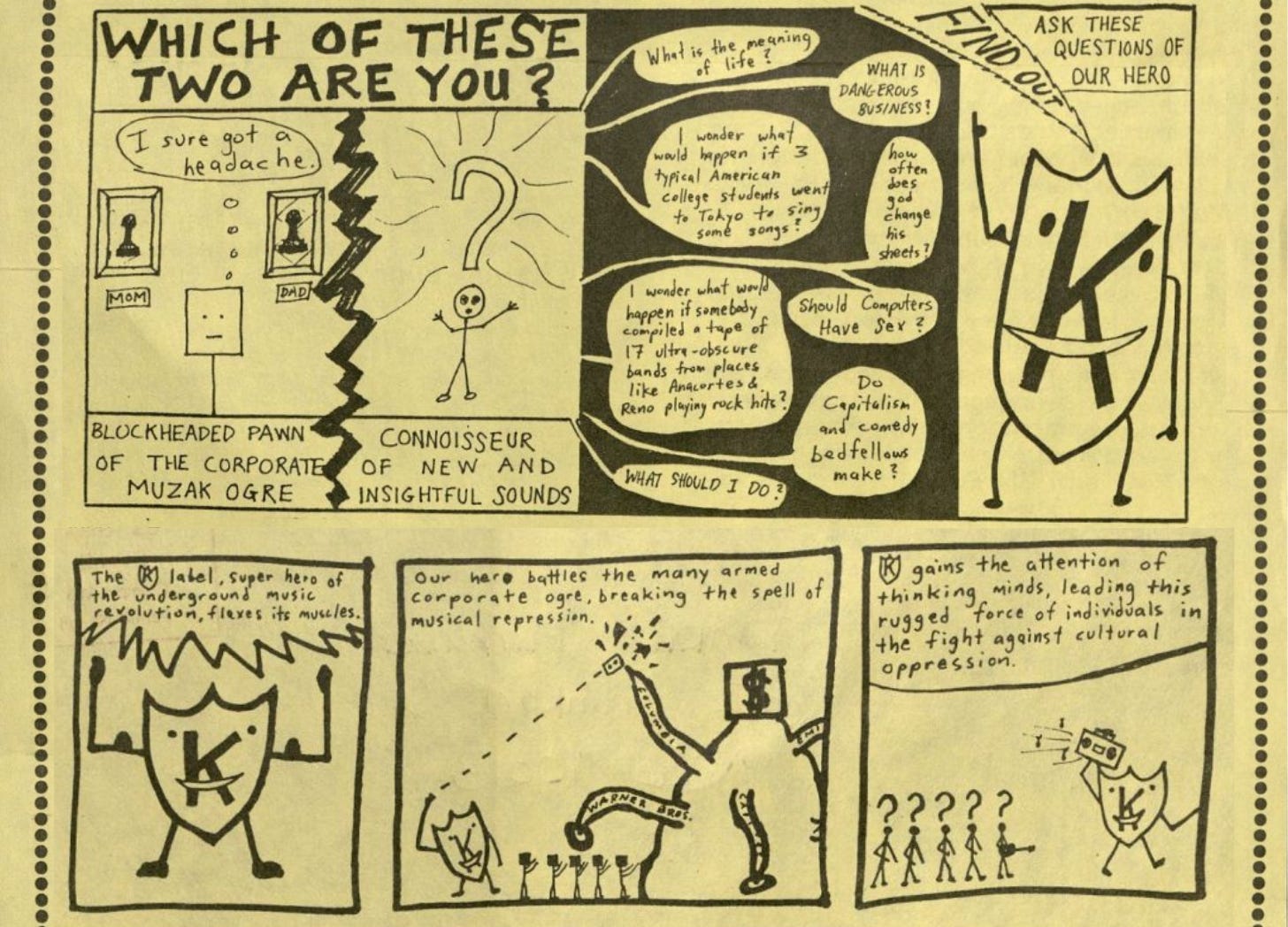
Inside twee are two wolves - one light, represented by Sarah Records, and one dark, represented by K Records, the brainchild of Beat Happening’s frontman Calvin Johnson. Beat Happening is the mascot of the punk-leaning, almost comically under-produced, sardonic, off-kilter, and often off-key path. The xeroxed zine come to life. The stylistic choice was quite intentional (Mark Lanegan co-produced this particular record, in fact). You’ll hear whispers of other eventually influential PNW genres starting to form: riot grrrl and grunge, most notably. For an infinitely rewarding rabbit hole, I highly suggest following all of Calvin Johnson’s threads — off to bands like Tiger Trap his short lived proto-riot grrrl label mates/signees (who would later spin off into The Softies, among others), then Bratmobile, their collaborators who debuted at Johnson’s International Pop Underground Convention in 19916, and off to Bikini Kill who shared the same stage… and on and on. I think you can write the rest.
Start with: “Indian Summer,” “Bewitched”
Also try: “Our Secret”
The Field Mice - Snowball [1989]
On the other side of the Atlantic, Sarah Records was releasing a lighter side of twee. Snowball is one of their more important records. If you expected more of the adorable, bedroom sound, here’s where you’ll find it. With their jangly guitars and indelible bass lines, The Field Mice are like a far sweeter version of The Smiths. The low production, DIY aesthetic is still very much present, but here there be sugar and spice and everything nice (in place of Beat Happening’s slime and snails and puppy dog’s tails). Much more palatable and pretty, certainly. They were arguably the progenitors of the (eventually) overused trope of the awkward, bookish boy who pines for the manic pixie dream girl. You may recognize the very first track as St. Etienne’s “Kiss and Make Up”; but theirs is the original, and only one year earlier!7
Start with: “Couldn’t Feel Safer,” “Let’s Kiss And Make Up”
Also try: “Emma’s House”
Heavenly - Le Jardin De Heavenly [1992]
If there were ever any “stars” of twee, then perhaps they would be Heavenly. Another of Sarah’s finest, they’ve been around in one form or another for at least 40 years (admittedly with a 30 year gap; they just released a new album barely a month ago), first as the equally infectious Talulah Gosh. Far more chipper and pop-centric than moodier Beat Happening and wistful Field Mice, Heavenly channels ‘60s music more directly: surf rock guitars, yé-yé girls and girl groups, twist and shout. Calvin Johnson released Heavenly’s records on his own label, which brought them modest acclaim beyond their own shores. It’s tough to call any band of the original twee class “big,” but their influence is undeniable: you’ll hear their legacy in Cub, The Cardigans, and Los Campesinos!, to name just a few. A standout of this album is also an example of how it bridged the oceanic twee divide: the K/Sarah crossover episode that is “C Is The Heavenly Option”8, in which Calvin Johnson joins Amelia Fletcher to sing a teen magazine quiz.
Start with: “C Is The Heavenly Option”, “Our Love Is Heavenly”
Also try: “P.U.N.K. Girl”
The Pastels - Mobile Safari [1995]
If the Scottish twee scene had a family tree, The Pastels would be at the root. Stephen Pastel’s 53rd & 3rd label hosted the likes of Talulah Gosh, The Shop Assistants, and Kurt Cobain’s favorite: The Vaselines. It’s tempting to describe their “shambling” style as a midpoint between the K/Sarah dark/light divide (and remember, I pulled that distinction out of my ass; I don’t know who else would subscribe to it!). But it’s not so far off from the truth. They have a charming messiness about them, a disconnect between their percussion and vocals that aligns well with the Calvin Johnson spirit. But the upbeat tempo and chiming, catchy melodies are more in tune with the “pristine pop” of Sarah. No need to compare, though. This was the way of the Scottish scene.
Start with: “Yoga”, “Strategic Gear”
Also try: “Nothing to Be Done”
Part 2: Tweevolution
What twee and twee-inspired albums came out after the records lionized by Pitchfork’s primer? Many didn't even hear about Twee until this later era, but there was a lot more going on even at this supposed height than you may have realized.
The Moldy Peaches - S/T [2001]
What would an anti-folk album be doing on a twee retrospective? Well, honestly, how did anti-folk come to be associated with the NYC sleaze of the early 2000s, anyway? (That’s a rhetorical question. We know how.) To the extent that twee was about sparseness, DIY, cutie patooties, crushes, and hand drawn photocopied album covers, Kimya Dawson and Adam Green were keeping it alive. I also maintain that they’re one of the main reasons it eventually developed into its later quirky, “adorkable” ModCloth-clad incarnation. After all, Juno walked so (500) Days of Summer could run.9
Start with: “Lucky Number Nine,” “Downloading Porn With Davo”
Also try: The Juno soundtrack, I guess, or Kimya Dawson’s solo work. This was The Moldy Peaches’ only album
Saturday Looks Good To Me - All Your Summer Songs [2003]
I threw this album on again for the first time in over two decades just for the sake of this article, and memories of how I described them to a friend at the time came rushing back to me: they sound like a sock hop played underwater. How could I possibly beat that? In seriousness though, frontman Fred Thomas was a fixture of the Michigan DIY scene, and it makes sense that there’d be a stronger, more audible connection to the Detroit soul music of the ‘60s and ‘70s. Think of this as twee through a more Motown, Phil Spector lens.
Start with: “Alcohol,” “Ambulance”
Also try: “The Girl’s Distracted”
The Blow - Poor Aim: Love Songs [2004]
On the one hand, it’s slightly disingenuous to call Khaela Maricich’s minimalist electropop twee. On the other hand, when I was hemming and hawing about whether to keep this album in the mix, I remembered that it was released on — you guessed it! — K Records. In fact, she was embedded in Calvin Johnson’s Olympia world, and even toured with him on Phil Elverum’s (Mt. Eerie/The Microphones) Paper Opera tour in 2001. So. Res ipsa loquitur. Plus, the absolute grip that this album had over me in my early 20s cannot be overstated. In many ways, these songs are even more precious and spare than most twee — just one girl, her synth, her drum machine, and her limerence to keep her company (“Hey boy - why you didn’t call me?/I waited for days, I can’t believe you didn’t call”). It almost feels like an exposed, tongue-out-of-cheek response to 69 Love Songs.
Start with: “Hey Boy,” “Come On Petunia”
Also try: “What Tom Said About Girls,” “Parentheses”
Strawberry Whiplash - Hits In The Car [2012]
This Glaswegian duo took their name from Strawberry Switchblade and Meat Whiplash, and their direct musical cues from the rest of C-86 and their descendants. This record stands out from its genre mates for its fuzziness. At times it almost veers into My Bloody Valentine territory (check out “Sleepy Head”), though it might not be approaching the full wall of sound. Dabbling in shoegaze is an interesting take on twee, one that they’ve extended onto last year’s People Like Us.
Start with: “Picture Perfect”
Also try: “Who’s In Your Dreams?”
Alvvays - S/T [2014]
After a bit of genre bending, we’re back in some seriously familiar Sarah Records territory with this delightful debut. This is more pristinely polished indie pop than it is twee, per se, which makes sense given their influences (The Smiths, Belle & Sebastian, The Magnetic Fields, and Celtic folk music besides). You’ll no doubt remember the heartrending “Archie, Marry Me” with all its lush reverb. After this retro record10, the band kept increasing the production value in future releases, culminating in 2022’s exceptional Blue Rev; perhaps the best album of the 2020s so far.
Start with: “Archie, Marry Me”
Also try: “Belinda Says”

Part 3: New Bands for Twee Heads
Another critical record label for indie pop through the decades (that still happens to actually exist!) is Slumberland. Their roster has featured Velocity Girl, Black Tambourine, Stereolab, Boyracer, The Pains of Being Pure At Heart, and an endless parade of other indie pop darlings. These days, if you want to find your favorite new twee band, you can throw a dart at their lineup and find one. It’s enough to make me feel like some of my selections are a bit of a gimme.
The Umbrellas - Fairweather Friend [2024]
This is the record that sent me plunging head first back into twee after so much time away. As soon as I heard Matt Ferrera’s voice on the opening of “Three Cheers,” I thought, “this sounds like Beat Happening’s been tuned up.” I can only imagine how appealing that will be to the vast majority of you who can’t understand for a moment why anyone would listen to tuneless vocals. In any event, this is a tight and polished indie pop record that channels the shambling, unpolished twee of its predecessors. Far more like The Magnetic Fields than The Vaselines.
Start with: “Three Cheers!”, “Games”
Also try: “Near You”
Neutrals - New Town Dream [2024]
Neutrals may be based in the Bay Area, but their lead singer/guitarist’s Glaswegian background is impossible to hide. Both his accent and the particular shambly/jangly style are front and center. There are echoes of Television Personalities, but the cranked up bass and slight disaffection in the vocals belie a strong post-punk influence as well. Not that strange, perhaps, given twee and post-punk’s shared punk roots.
Start with: “Wish You Were Here”, “That’s Him On The Daft Stuff Again”
Also try: “Half Shut Knife”
Jeanines - How Long Can It Last [2025]
I like my indie pop with a little bit of grit, which Jeanines delivers without damaging any of their sweetness. The more I listen to this duo, the more they remind me of early Belle & Sebastian tracks. I find that much like The Umbrellas, they have the uncanny ability to write songs that feel entirely out of time. If you told me that this album had been recorded in 1966 or 1989, I would have believed you.
Start with: “Coaxed A Storm”, “Satisfied”
Also try: “Winter in the Dark”
Sharp Pins - Radio DDR [2025]
Outside of the phenomenal Slumberland roster, we have Kai Slater, the phenom/wunderkind behind not one but two of last year’s stellar breakout indie acts: Lifeguard and Sharp Pins. This is the first of two 2025 Sharp Pins releases, and a testament to Slater’s dedication to the spirit behind twee, if not the literal sound. I’ve previously described his records as reminiscent of Guided by Voices covering the Beatles - lo-fi, yes, but perhaps better described as the slacker rock version of twee than the sugary DIY pop of the first wave.
Start with: “Circle All The Dots”, “When You Know”
Also try: “Popafangout”
cootie catcher - Something We All Got [2026]
For another departure from the Slumberland roster and a bit more of an experimental option, Cootie Catcher offers up a blend of glitch-pop and indie pop. As Indie Scientist and I explained a few weeks ago, they “take that distinctive twee, DIY sound of K Records in the late ‘80s and early ‘90s and make it their own. Their eclectic mix of jangly guitars and twitchy/glitchy ‘twee-tronica’ makes for a very satisfying unpredictability.”
Start with: “No biggie”, “Puzzle pop"
Also try: “Friend of a friend”
What did I miss?
Trick question. I missed so, so much. That’s why you’ll have to come back next week. But still, I want to know: what are your favorite twee bands and records?
More???
Yes. So much more. Playlists and poking deeper into the nooks and crannies of twee. Next week, I said! Next week!
But! Since next week’s post is going to be for paid subscribers, how about a chance to win a few free months of paid access (and some free music)?
Send me a photo of yourself showing off your NBfOH merch; win fabulous prizes.


Until next time.
xo
Gabbie
I recently became aware that an infant born in 2005 can now legally drink. I will give you a moment to recover.
This iTunes intranet-hopping was how my music discovery worked back then. Sometimes it would be through one genre, yes, but most of the time I just sank my teeth into an entire record label’s roster until I had exhausted it completely. Or I followed one band’s evolution backwards, forwards, and sideways until I knew the work of every single member individually and together. My educational trajectory into music was messy and circuitous, to say the least.
Not the ideal time to visit the Czech Republic, if you’re planning to go.
Later, it hit me why this particular song felt so familiar — it had been featured, like so many other incredible songs, on Nickelodeon’s Pete & Pete. What a show!
Don’t worry, I obviously made it into a playlist so you don’t have to. Check back in next week.
Along with Modest Mouse.
Not that Beat Happening didn’t enjoy their fair share of covers, including R.E.M.’s cover of “Indian Summer.”
Speaking of Los Campesinos!, they covered this track, and it’s quite fun.
Fun (?) fact: this album came out on 9/11, and includes a track called “Nyc’s A Graveyard.” It’s actually a banger, but geez.
Help, I can’t stop alliterating!
As something of an indie pop scholar, I really enjoyed this! Also, I still believe "Twee as Fuck" is the single best feature Pitchfork has ever published.
I’ve just got back from Wales Goes Pop - where I saw the lovely sight of Radhika (21 last week and daughter of one of the Soup Dragons) talking with Rachel Love of Dolly Mixture.
Our daughter was down the front for Heavenly (and grabbed a set list) - 36 years ago they headlined the first gig I put on.
(I can also claim partial responsibility for the indiepop-L mailing list, or at least for the more goth people on the 4AD list suggesting we found another place to talk Creation and Sarah)
FWIW - my personal starting point would be Orange Juice, Dolly Mixture, TVPs and Marine Girls. At least in the U.K, I think between them they invented the ‘twee’ aesthetic. Although it’s a bit retrospective, at the time didn’t really separate it out from the rockist fuzzy Mary Chain noise stuff or early Pastels like Baby Honey which wasn’t very twee at all.