

We Listen and We Judge
Finding your new music discovery sweet spot

I was at an outdoor bar in Bologna with my cousin and my friend when Angine de Poitrine started playing.
Both of my drinking companions are musicians and had already spent the previous twenty minutes talking about theory while I contributed exactly nothing to the conversation. The place was trendy and their music selection had been solid until then, so it was only a matter of time before they would start playing Angine de Poitrine. That would be my moment to shine.
My cousin’s ears perked up. “What is this? It’s polyrhythmic.”
“Oh, that’s Angine de Poitrine.” So smug. See, I know things. “They’re blowing up right now.”
He wondered out loud how many musicians it would take to produce the sounds we were listening to. I was happy to unveil my second fact of the day. “It’s just two guys!” I started loading the KEXP video while he argued with me.
The second he saw the costumes and the view counts, his face fell. “Okay, I get it. It’s a gimmick.” I knew he’d never listen to them again.

Meanwhile, my friend1 had been politely nodding along. He wasn’t quite as unplugged as my cousin — a classically trained bassist who’s chronically suspicious of popular music — but just because he’d heard of the band didn’t mean he was interested.
“It’s just prog rock, isn’t it?” He was visibly annoyed. “We’ve heard it all before.” The recent commotion about their ingenuity left him cold. The complexity that intrigued my cousin was old hat for him.
So, Angine de Poitrine didn’t land for either of them. It didn’t fit into their music discovery “comfort zone,” if you will. My cousin needed fewer theatrics. My friend needed more originality. I found myself wondering how they would react if that KEXP video had never gone viral.

We Listen and We Judge
We like to think that as long as the music is good, it can survive any context. But there’s no escaping context. There’s no such thing as a pristine music lab where we can test our taste in a complete vacuum. Context is ever-present and it informs our taste.
How we arrive at new music - how it’s packaged and presented to us when we first hear it – matters almost as much as the music itself. In other words, every new recommendation is filtered through both your taste and your receptivity.
It’s why all of those people wondering whether they can trust their own taste after learning about the whole “Geese is a psyop” nonsense discourse are asking themselves the wrong question, because the marketing got them to listen in the first place.
As somebody who provides context for music for a semi-living, I’ve been thinking for a long while about what makes us most and least receptive to new music. A trusted source is probably priority number one. After that, I kept coming back to two completely unquantifiable variables: hype and accessibility. The two things that my Bologna bar mates had unwittingly identified as obstacles.
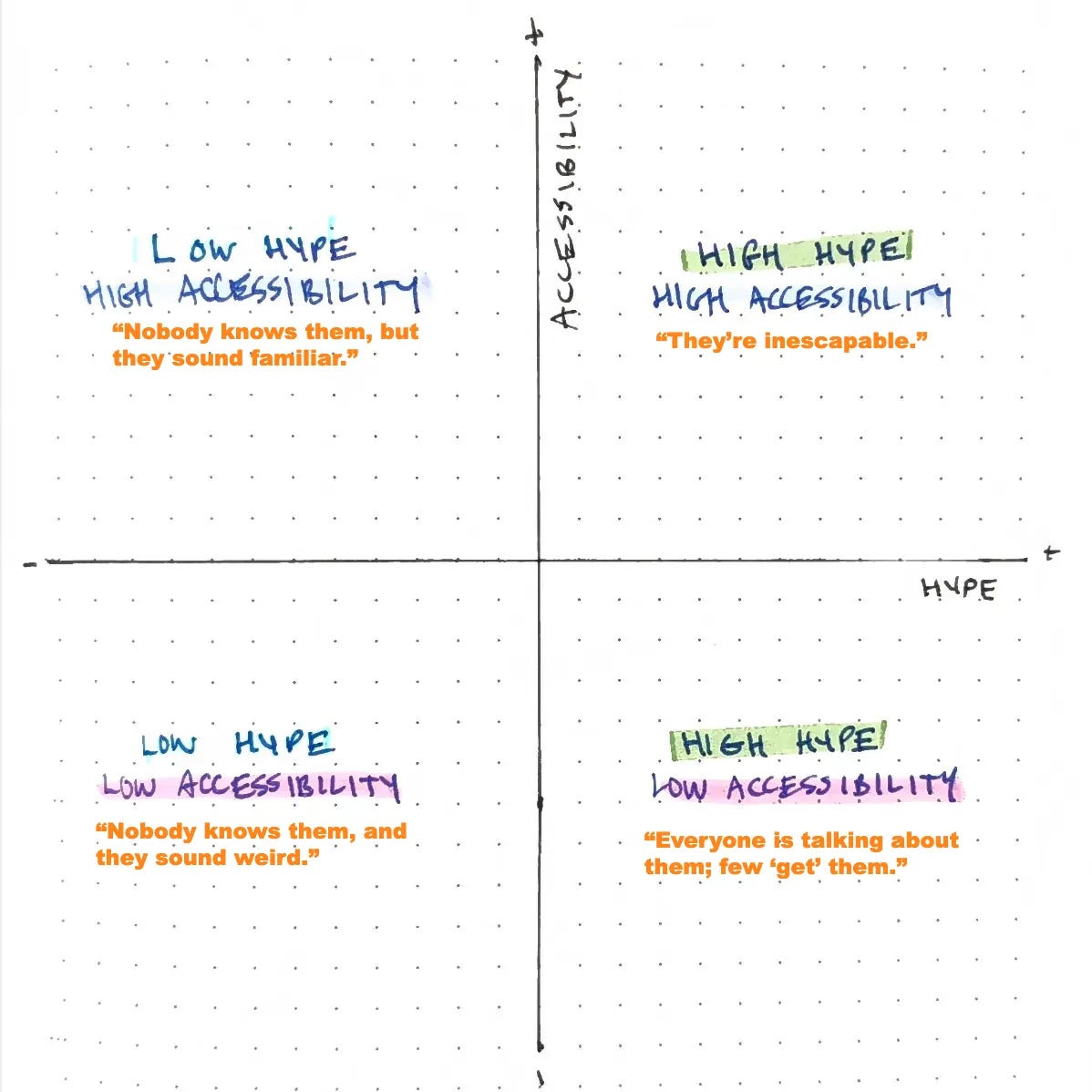
Oh, how I wanted to plot bands on this graph! I tried. It was a disaster. I thought I could put Angine de Poitrine (the only band I’ve heard of) in the High Hype/Low Accessibility quadrant. Easy. But I literally just told you how accessible they were to my friend. It turns out that your own experience colors your perception. Crazy.
I’m incredibly stubborn, so I’m going to keep the chart. I’m even going to make you do some homework, because you should map bands you like and dislike on the chart for yourself. Getting rid of context isn’t the point. Maybe we can call it decluttering context instead.
Let’s start with a bit of clarification before we jump into activities:
What do I mean by “accessibility”?
Generally we call music accessible when it has conventional structure (predictable time signatures, easy-to-play chords, verse-chorus-verse construction, catchy hooks, etc.) or is otherwise “unchallenging.” But it can be accessible to you personally because it is familiar to you, because it reminds you of something else that you love (complex or not!), or scratches a particular itch in your brain.
What do I mean by “hype”?
It’s easy to treat hype and popularity as synonyms, but it ain’t necessarily so. From my perspective, popularity is far more broad (think Taylor Swift), whereas hype stays in particular circles (Geese post-Getting Killed for the music nerd set, but not for gen pop SNL viewers). Whatever is generating buzz in your bubble has hype.
(Note: Neither of these terms has any kind of moral weight. They can be positive or negative. You might seek these out or you might avoid them.)
What’s your music discovery sweet spot?
We’ll start with the easier question: what conditions make you most receptive to new music discovery? What context makes the experience better for you?
Think of a handful of new bands or artists you recently learned about and really enjoyed. How would they fit on your personal hype vs. accessibility map?
I can’t plot them for you2, but I can give you some hints.
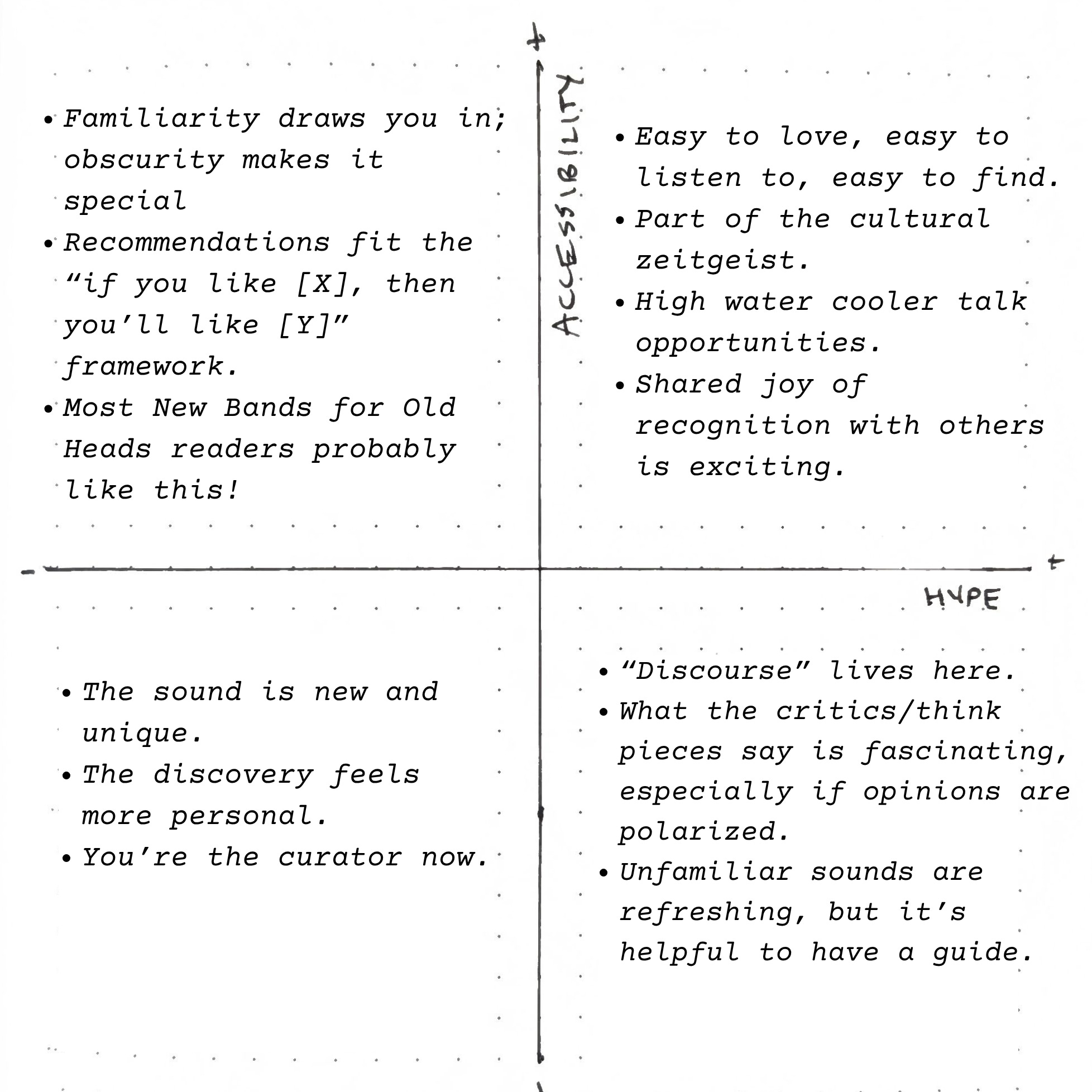
It may help to see likely discovery methods mapped on the chart, too. If you can think about how you learned about the new artist you recently enjoyed, or how you prefer to learn about new music generally, that can also be your guide.
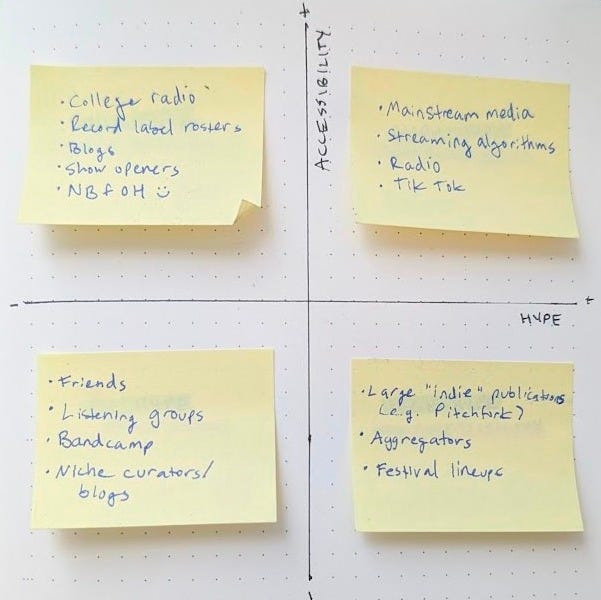
I suspect most of this newsletter’s readers3 are primed to discover music that is lower on the hype scale and higher on the accessibility scale — music that sounds familiar from bands that are totally new to you.
You know yourself better than I do, though.
Are you most receptive when music arrives untainted by mass hysteria? Are you more likely to enjoy something when you know thousands of others already do? Or is being the only one “in the know” the most exciting part of hearing a new band?4
What’s your music discovery no-go zone?
This might be a harder question to answer, at least publicly, but It’s also the more important one — I’d start with this one if you’re too lazy to run through the full chart mapping exercise:
What conditions make you least receptive to new music discovery? What context makes the experience worse for you?
We all want to think of ourselves as incredibly open-minded. If you didn’t like something, it’s because you weren’t in the mood, or because it’s straight up bad, right?
But even if nothing shuts you down entirely, there are still situations that make you less receptive to hearing, listening to, or enjoying new music, no matter what it sounds like.
Look at the chart again and think about a new band that didn’t land with you recently. Especially one where you can’t quite pinpoint what it is you dislike. What were the circumstances surrounding your first encounter with them?
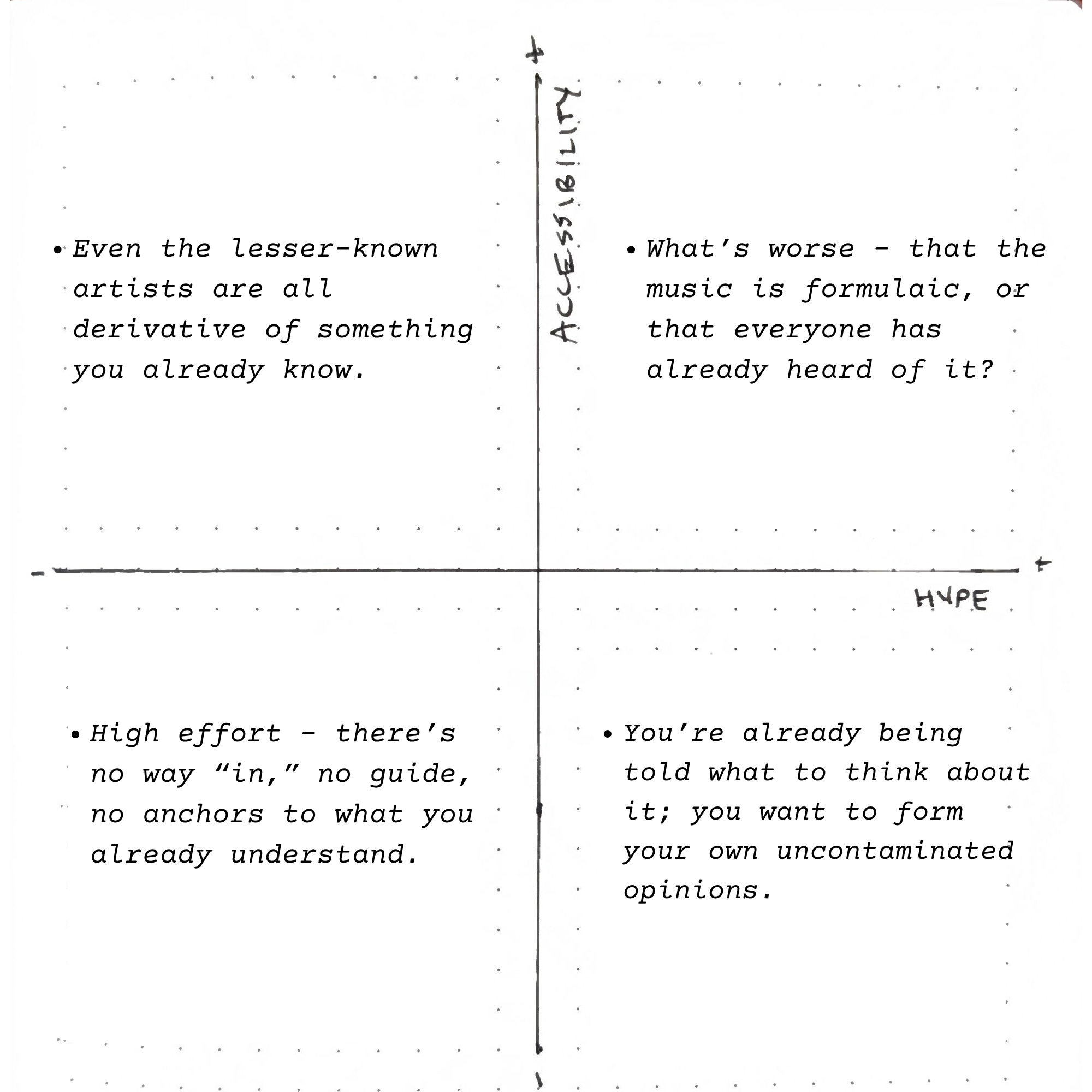
I’ll go back and answer for my cousin and my friend. At least for Angine de Poitrine (the only band to exist), my cousin was bristling against high hype/low accessibility. The “weirdness” might have been okay if it were simply part of the musical experience, but extending it to the band’s whole raison d’être was a bridge too far. For my friend, it was both high hype and high accessibility that pushed him away.
As for you — what stands in the way of taking a new band on board?
Know Thyself
What are you supposed to do once you have a better idea of your turn-ons and turn-offs?
What you’ve learned about yourself can help you become more open-minded and open-eared. This is why I said that the second chart — the one about what prevents you from receiving new music well — is the more important one.
A few examples:
If hype or discourse overwhelm you, “mute” it. You can’t help how you learned about a band in many cases, but you can control how much you dig into them. I, for one, treat music reviews like spoilers.
Before writing it off, name what’s in the way. It’s like naming your feelings in therapy!
Revisit first impressions after a break. I don’t trust first impressions, anyway.
Seek out what’s outside of your comfort zone. When I was a kid, I hated olives but thought no self-respecting adult could possibly hate olives. So I made myself eat them, trying them in new ways and with different foods. Now I love them. Maybe you can do that with pop music?
You’re allowed to just not like stuff, too. But if you’re trying to build up your taste or want to understand what the fuss is, it’s worth a shot.
Context, Context, Context
The purpose of this exercise isn’t to box you in to one quadrant. You may feel totally agnostic about accessibility, but hype sours you. You may prefer music that sounds familiar to you, and be fully ignorant of hype. Every square might apply to you at some point or another.
What’s more, you (or the music you listen to, or the way you prefer to discover music) may simply not “fit” into the chart at all. Hype and accessibility are just two of countless factors that influence your receptivity. They may not even be the ones that matter most to you; perhaps a single trusted curator’s recommendation could override every other obstacle you have. There’s a reason I felt like throwing the chart into the trash after staring at it for so long.
I still stubbornly insist that it’s helpful to think about.
Stepping back to analyze your taste more holistically, regardless of which factors you use to make the assessment, can help you nail down preferences beyond genre, especially if you’re trying to identify why something didn’t land. Like it or not, outside influences will always shape your willingness to listen, and your willingness to listen (your receptivity!) factors into your taste.
And isn’t that kind of self-reflection the entire purpose of deliberate listening?

For what it’s worth, I did try my hand at plotting recent New Bands for Old Heads recommendations (and I’ll share it with you if you’re curious). It was a silly idea, in part, because I only recommend what I already love. But it did reveal something about my preferences:
I’m far less excited to listen to new music on the higher hype scale, even if I eventually end up loving it. Call it a hazard of being unyieldingly plugged in, but I find myself craving more unusual sounds from lesser known artists. I put off listening to higher hype releases, sometimes indefinitely. It usually takes multiple personal recommendations for me to take the plunge. For all of my poptimist leanings, I have to concede that emerging artists will get my attention far more quickly. Because I know that I’m equally likely to love those hugely hyped records as the unknown ones, I’ve eliminated some pressure to hold off on them.
As for my cousin and my friend?
I can’t rerun that perfect experiment that sent me spiraling down this staircase. They can’t hear Angine de Poitrine (the only people who have ever made music) for the first time again. That bar in Bologna was probably the closest I’d come to a pristine listening lab… before I ruined it with all that pesky context, anyway.
I do wonder whether they’d be more willing to give it a second or third listen if they knew a bit more about what makes them tick.
Actually, a reader who’s been living in Italy for decades and kindly offered to show me around — he’s the leader of a new wave band that’s worth listening to, as well.
I guess I could have thrown a few into the top right, but that’s still making assumptions.
Though probably not its commenters!
I mentioned this question to Queen Kwong the other day, and she told me that “people need to feel like they’ve discovered something.” I love this observation, but does hype necessarily ruin that experience for everyone?